The Real Truth: Sony Bravia 8 Ii or Kaleidescape Strato E?
Introduction
The pursuit of the ultimate home cinema experience often leads enthusiasts down two distinct yet intersecting paths: the search for the perfect display and the quest for the highest-quality source component. In the current landscape of high-end home theater, few names carry as much weight as Sony and Kaleidescape. Traditionally, these two entities exist in harmony—one providing the visual canvas and the other providing the digital brushstrokes. However, as home ecosystems become more complex and budgets more scrutinizing, a fundamental question has emerged among luxury AV buyers: which component defines the "truth" of the cinematic experience? Is it the Sony Bravia 8 Ii, a flagship OLED display that represents the pinnacle of consumer panel technology, or the Kaleidescape Strato E, a movie player that promises a bit-for-bit fidelity far surpassing anything found on streaming services or physical media?
This comparison is unique because it pits a display against a source. While a consumer ideally wants both, the reality of high-end upgrades often forces a choice. Do you upgrade your 4K OLED to the latest Sony Bravia 8 Ii to gain better brightness and processing, or do you stick with your current high-quality display and introduce the Kaleidescape Strato E to finally feed it the uncompressed data it deserves? This article explores the real truth behind these two powerhouses, analyzing their technical merits, their practical roles in a modern living room or dedicated theater, and how they individually impact the viewer’s perception of reality. By understanding the nuances of Sony’s Cognitive Processor XR and Kaleidescape’s lossless ecosystem, homeowners can make an informed decision on where the next five figures of their AV budget should be directed.
Detailed Analysis: Sony Bravia 8 Ii OLED
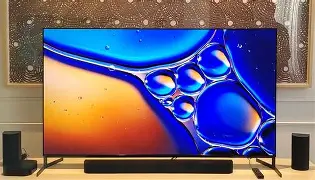
The Sony Bravia 8 Ii represents the second iteration of Sony's refined OLED strategy, focusing on the balance between pure blacks and peak luminance. Sony has long been regarded as the "director’s choice" in the television world, primarily because their internal processing aims to match the look of their professional BVM monitors used in Hollywood mastering suites. The Bravia 8 Ii is built upon a high-performance OLED panel, but the secret sauce lies in the Cognitive Processor XR. This chip doesn't just upscale resolution; it analyzes the focal points of a scene—much like the human eye does—and enhances detail, contrast, and color to create a sense of three-dimensional depth.
One of the most significant upgrades in the Bravia 8 Ii is its handling of near-black detail. Lower-tier OLEDs often struggle with "crushing" blacks, where dark shadows lose all texture and become blobs of ink. Sony’s latest algorithm ensures that even in the dimmest corridors of a horror film, the viewer can distinguish between the fabric of a character’s coat and the shadow cast behind them. Furthermore, the integration of Acoustic Surface Audio+ means the screen itself is the speaker. For many buyers, this eliminates the initial need for a bulky soundbar, as the sound emanates directly from the mouths of the actors on screen, reinforcing the immersion that high-end buyers demand.
In real-world use cases, the Bravia 8 Ii excels in environments where lighting can be controlled but isn't necessarily a total blackout. Its anti-reflective coating has seen incremental improvements, making it a viable center-piece for a multi-purpose living room. However, it remains a television first and foremost. It is subject to the limitations of the content fed into it. Whether it is an 8-bit compressed stream from a popular app or a high-bandwidth 4K disc, the Sony works overtime to "clean up" the signal. This leads us to the fundamental tension of this comparison: a great TV can only do so much with a mediocre signal.
Pros and Cons of the Sony Bravia 8 Ii
- Pro: Industry-leading motion handling and upscaling via the Cognitive Processor XR.
- Pro: Perfect black levels and significantly improved peak brightness for highlights.
- Pro: Acoustic Surface Audio+ provides an immersive, "invisible" soundstage.
- Pro: Professional-grade color accuracy out of the box with minimal calibration required.
- Con: High cost of entry compared to competing OLED panels with similar hardware.
- Con: Still limited by the bit-rate and compression of internal streaming apps.
- Con: Risk of permanent image retention (burn-in) if used primarily for static news tickers or HUDs.
Detailed Analysis: Kaleidescape Strato E
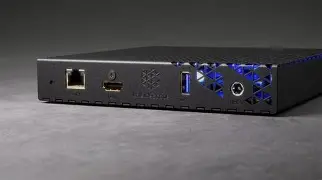
If the Sony Bravia is the "eye" of the theater, the Kaleidescape Strato E is the "brain." To the uninitiated, a movie player that costs as much as a flagship TV might seem like an extravagance. However, the Kaleidescape ecosystem is built on a simple, uncompromising truth: streaming is not cinema. Even the highest-quality 4K streams from platforms like Netflix or Disney+ are heavily compressed, typically operating at bitrates between 15mbps and 25mbps. In contrast, the Strato E delivers movies at bitrates up to 100mbps, with lossless audio tracks (Dolby Atmos and DTS:X) that are identical to the studio masters.
The Strato E is the entry point into this world, designed as a standalone player that can also act as a server for other small players in the house. It features a high-speed internal drive capable of storing dozens of 4K titles. The experience of using a Strato E is entirely different from scrolling through a laggy smart TV interface. The Kaleidescape movie store offers thousands of titles, often available weeks before they hit physical discs, and once downloaded, they play instantly without buffering, ads, or trailers. The "truth" of the Strato E is found in the micro-details: the individual pores on a face, the lack of "banding" in a sunset, and the thunderous, uncompressed floor of a well-mixed action sequence.
Find top-rated TVs & Home Theater products at great prices.
Browse Now →For the buyer who already owns a decent 4K TV, the Strato E represents a transformative upgrade. It removes the "bottleneck" of the internet. In real-world scenarios, many users find that a three-year-old high-end TV looks better playing a Kaleidescape file than a brand-new TV looks playing a 4K stream. The Strato E also integrates deeply with home automation systems. When you press play, the lights can dim automatically, the curtains can close, and the screen masking can adjust to the exact aspect ratio of the film—features that no smart TV internal app can replicate reliably.
Pros and Cons of the Kaleidescape Strato E
- Pro: Unmatched bit-for-bit video and audio quality that outperforms 4K Blu-ray and streaming.
- Pro: Zero buffering and instant playback of downloaded content.
- Pro: The most elegant and metadata-rich movie interface in the world.
- Pro: Deep integration with luxury home automation systems (Crestron, Savant, Control4).
- Con: Extremely high cost for the hardware and the movies themselves.
- Con: Requires a robust internet connection to download large files (often 60GB to 100GB per movie).
- Con: It is a source component only and requires a high-quality display to be useful.
Technical Comparison
When choosing between these two components, it is helpful to look at how they address specific pillars of the home cinema experience. The following table highlights the technical priorities of each device.
| Feature | Sony Bravia 8 Ii | Kaleidescape Strato E |
|---|---|---|
| Primary Role | Visual Panel / Output Device | Content Source / Playback Server |
| Video Processing | Cognitive Processor XR (Enhancement) | Bit-for-Bit Studio Master (Purity) |
| Audio Capability | Built-in Acoustic Surface Audio+ | Lossless Bitstream (Atmos/DTS:X) |
| Interface | Google TV (App-based) | Proprietary Kaleidescape OS |
| Content Source | Streaming/HDMI Inputs | Encrypted Download Store |
| Maximum Bandwidth | Limited by Wi-Fi/Ethernet for apps | Up to 100+ Mbps (Internal Drive) |
The Buying Guide: Which "Truth" Do You Need?
Deciding between the Sony Bravia 8 Ii and the Kaleidescape Strato E requires an honest assessment of your current setup and your viewing habits. Far too often, consumers buy a $5,000 television and then feed it $15-a-month compressed streams, effectively using only 50% of the TV's potential. Conversely, some enthusiasts buy a Kaleidescape and plug it into a mid-range LED display that cannot reproduce the high dynamic range and color depth the player provides.
Scenario 1: The Display Upgrade
You should prioritize the Sony Bravia 8 Ii if you are currently using a display that is more than four or five years old, or if you are moving from a standard LED/LCD to your first OLED. The jump in contrast ratio and "infinite" blacks provided by the Bravia 8 Ii will be the most noticeable change for the average viewer. If you spend most of your time watching high-quality terrestrial broadcasts, sports, or gaming on a PlayStation 5, the Sony is the runaway winner. Its processing creates a polished, "expensive" look for all content types, making even lower-resolution signals look respectable.
Scenario 2: The Source Upgrade
You should prioritize the Kaleidescape Strato E if you already own a high-quality 4K display (such as an older Sony A90J or a LG G-series) and feel that movies "lack a certain something" compared to the local cinema. If you find yourself frustrated by the macro-blocking in dark scenes on Netflix, or if you have a high-end surround sound system that feels under-utilized, the Strato E is the missing piece of the puzzle. It transforms a good home theater into a world-class one by ensuring the display is never the smartest thing in the room—the content is.
The Real-World User Conflict
Buyers typically care about three things: ease of use, visual "pop," and future-proofing. The Sony Bravia 8 Ii wins on ease of use because everything is contained in one box. You turn it on, hit the Netflix button, and you have an image. However, the Strato E wins on "pop." There is a specific clarity in uncompressed 4K video—a "window-like" effect—that no amount of Sony processing can fake. Regarding future-proofing, the Kaleidescape hardware tends to hold its value and utility longer than a television, as panel technology changes faster than the format of a 4K movie file.
Integration and Synergy
The "Real Truth" is that these two products are designed to work together. Sony’s processing is at its best when it has a clean signal to work with. When the Cognitive Processor XR receives a 100mbps signal from a Strato E, it doesn't have to spend its "energy" removing compression artifacts or smoothing out noise. Instead, it can focus entirely on color gradation and spectral highlight management. In high-end custom installations, the Sony Bravia 8 Ii is frequently the "monitor" for a Kaleidescape-driven system.
Find top-rated TVs & Home Theater products at great prices.
Browse Now →Furthermore, the Strato E manages the metadata of your library in a way that assists the Sony. When the Strato E tells the Sony exactly what the frame rate and aspect ratio are, the TV can adjust its motion settings and zoom modes to perfection. This synergy provides a cinematic experience that is often superior to the local multiplex, where projectors are frequently misaligned or dim. In your home, with this combination, you are seeing the film exactly as the colorist saw it in the studio.
The Impact of the Physical Environment
The room in which you watch also dictates the choice. The Sony Bravia 8 Ii is a versatile king. It can handle a Sunday afternoon football game in a sun-drenched room just as well as it handles a midnight screening of a moody noir film. Its high peak brightness allows it to fight through glare. If your theater is your living room, the Sony is the safer, more logical investment.
The Kaleidescape Strato E, however, is built for the "event." It is for the person who sets aside time to watch a film from start to finish. Because it requires a download period (usually 10-45 minutes depending on internet speed), it discourages mindless "channel surfing." It encourages curation. For the dedicated theater owner with a dark room and a massive sound system, the Strato E is not a luxury; it is a necessity. Feeding a $50,000 theater with a $20 stream is like putting low-octane fuel in a supercar.
Conclusion
The choice between the Sony Bravia 8 Ii and the Kaleidescape Strato E comes down to where your current bottleneck lies. The Sony Bravia 8 Ii is the ultimate refinement of the television, offering a visual experience that is strikingly beautiful, deeply immersive, and incredibly smart. It is the best way to make everything you watch look better. However, it cannot manufacture data that isn't there. It remains a "lipstick on a pig" scenario when fed poor-quality streams.
The Kaleidescape Strato E, on the other hand, provides the data. It is the only way to see the full potential of any 4K HDR display. While it does not provide the "light" itself, it provides the most purist, unadulterated digital signal available to consumers. The real truth is that for most people, the Sony Bravia 8 Ii is the logical first step in building a luxury theater. But for those who have already achieved visual excellence and find themselves wanting more, the Strato E is the only component capable of delivering the absolute truth of the cinematic master. Both represent the pinnacle of their respective categories, and while they serve different functions, they both share a common goal: disappearing and letting the story take center stage.